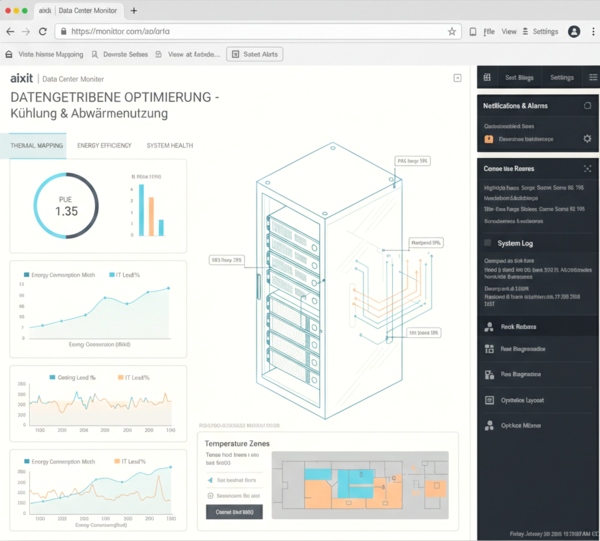
In classic colocation environments, IT systems are primarily placed according to space availability and client allocation. The thermal properties of individual servers—such as power consumption, waste heat generation, or load profiles—are largely ignored. The physical layout of the data center is thus rarely used as a strategic variable for energy efficiency or waste heat utilization.
Against this backdrop, aixit conducted an internal scientific innovation project to investigate the potential of consistently thermally optimized server placement. Based on real measurement data, servers were systematically analyzed and classified into thermal classes. In a next step, these classes were hypothetically combined into temperature zones to investigate the effects on cooling requirements, cold overprovisioning, and the targeted usability of waste heat.
A particular focus was placed on the interaction between cross-client placement concepts and modern cooling architectures. The analysis examined how cascading cooling concepts can be implemented, in which waste heat is reused at different temperature levels. The central methodological challenge was to quantitatively capture these relationships without interfering with productive data center operations.
The research approach developed combines the evaluation of real power and temperature data with data-driven classification methods, virtual layout models, and simulation-based scenarios. This made it possible to systematically compare different placement and cooling strategies and reveal their efficiency potential. In contrast to classic optimizations of individual components, aixit explicitly considers the data center as a thermally coupled overall system.
The findings provide a sound basis for long-term energy-efficient operating strategies in colocation data centers. At the same time, the project underscores aixit's commitment to innovation: conducting research not in isolation from operations, but as a practical, data-driven examination of real-world constraints and sustainable infrastructure concepts.