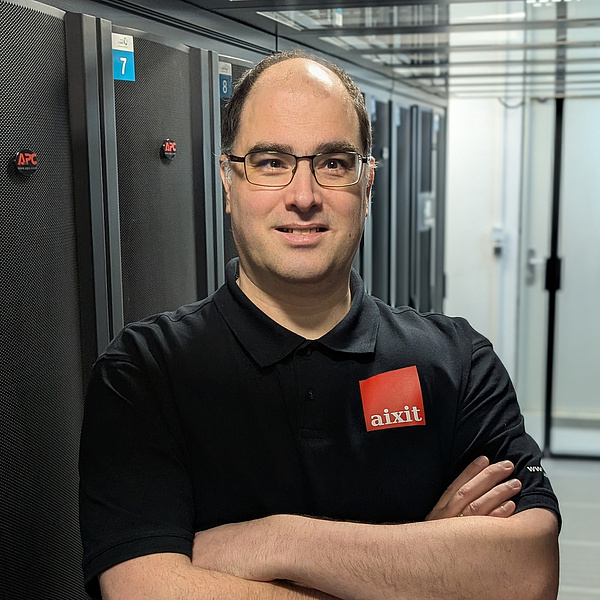
Holger, for a long time it felt as though AI was primarily a topic for hyperscalers. Are you now observing a different development?
Absolutely. We are clearly seeing that AI is not taking place exclusively within the large cloud ecosystems. The Mittelstand is also experimenting, developing, and implementing intensively.
As a colocation provider, we don’t always see this at the application level — after all, we primarily rent out infrastructure. But we see it physically: rising peak loads, changing performance profiles, new requirements for cooling and power supply.
These are no longer random fluctuations. This is structural change.
What is changing technically, specifically?
A key term is thermal heterogeneity.
In the past, a server room could be planned relatively homogeneously. Today, we are seeing very different performance and heat profiles within individual racks. AI workloads generate massive performance densities in very confined spaces.
This calls the classic “average model” of colocation into question — meaning the assumption that performance values balance out on average. That assumption is becoming less and less valid.
This forces us to rethink.
Does this mean a fundamental adjustment for providers like aixit?
I would say: we are facing strategic decisions.
The question is not whether something is changing — but how we, as a medium-sized data center operator, respond to it. Do we remain purely a provider of infrastructure space? Or do we further develop ourselves as a systems partner for new load models?
That is not an easy decision. And it cannot be answered immediately. But it must be asked.
Do you see this more as a threat or as an opportunity for the Mittelstand?
Above all, I see responsibility.
The Mittelstand in Europe is not a marginal phenomenon; it is the backbone of the economy. If AI applications in the future could only be realized within a few global structures, we would have a strategic problem.
At the same time, this very situation opens up opportunities: If we rethink digital and physical infrastructures, this automatically creates new requirements for energy and cooling concepts — and thus new occasions for European cooperation.
The question is whether we have the courage to actively shape these topics.
In this context, aixit is also applying to participate in research projects. Why is this relevant for you?
Let’s take IPCEI as an example — it stands for “Important Project of Common European Interest,” meaning initiatives that deliberately think beyond the current state of the art and pursue strategic European objectives.
We do not only want to react to market changes, but to actively participate in research and innovation processes. Especially when it comes to topics such as performance density, energy efficiency, and resilient infrastructure, new ways of thinking are required.
And these rarely emerge in isolation.
If you look ahead — what makes you optimistic?
What makes me optimistic is that we are currently experiencing a phase in which many things are being renegotiated.
Technically, economically, geopolitically.
We see enormous innovative strength within the Mittelstand. We see European initiatives that think strategically. And we see infrastructure issues moving back to the center of the discussion.
I do not believe there will be one single solution. But I do believe that we are asking the right questions.
And that is often the first step in the right direction.
AI is fundamentally transforming infrastructure requirements.
If you would like to exchange ideas on workload density, energy efficiency, or European research initiatives in the data center environment, please feel free to contact us at:
forschung@aixit.com